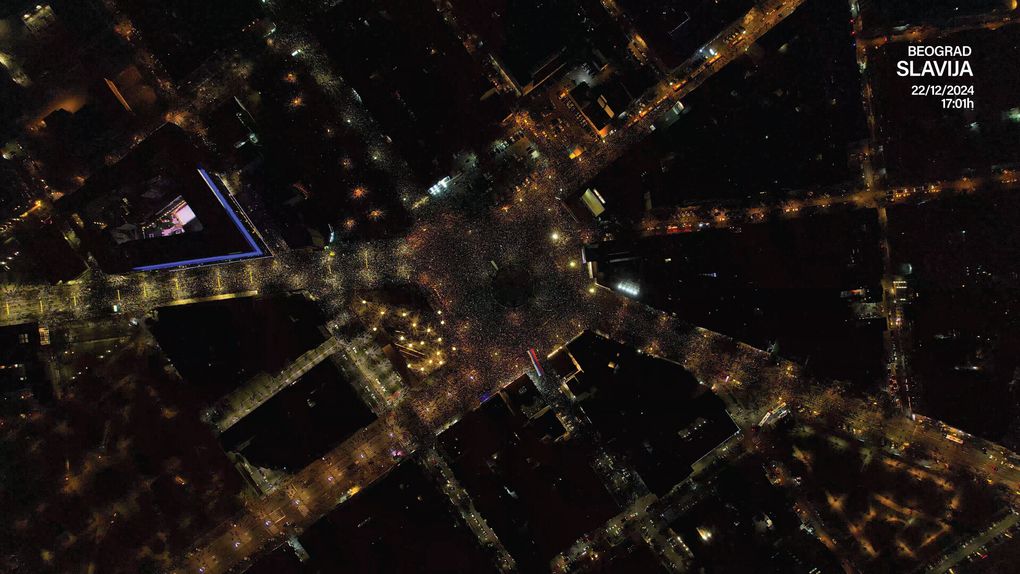
The collapse of the canopy at the Railway Station in Novi Sad on Friday, November 1, 2024, at 11:52, killed 15 people. The death of innocent victims caused collective sorrow. Citizens paused in the streets at 11:52AM to honor the victims with a 15-minute silence. People in Serbia continue to gather regularly in various locations across the country, always at the same time – 11:52.
Get Involved
The Student Movement in Serbia currently operates as a broad network, spanning faculties, cities and social media, without a central leadership. There are many ways you can support us, the students and our struggle.
News
Upcoming public actions and events organized by students in the blockades of higher education institutions in Belgrade. See the announcements of actions that await us in the coming period, find out more about the plan of activities, see the map or follow how the event is developing live.
Demands
- The publication of the entire documentation related to the reconstruction of the Railway Station in Novi Sad, which is currently unavailable to the public.
- We demand confirmation from the competent authorities regarding the identity of all individuals reasonably suspected of physically assaulting students and professors, as well as the initiation of criminal proceedings against them. We also demand the dismissal of these individuals if it is proven that they are public officials.
- The dismissal of criminal charges against the arrested and detained students at the protests, as well as the suspension of any ongoing criminal proceedings.
- Increase in the higher education budget by 20%.
- We demand a thorough investigation by the competent authorities to determine all circumstances and liabilities regarding the phenomenon that caused fear and panic on March 15, 2025 at 7:11 PM along Kralja Milana Street, during a peaceful protest and 15 minutes of silence in memory of the tragic victims in Novi Sad.
- Responsibility and protection for patients.
Student in Every Village
The working group called Student in Every Village (Student u svakom selu, SUSS) is a unit within the Student Movement that visits communities across Serbia. Over the past year, we have visited more than 400 communities, more than 40,000 households, and spoken with more than 20,000 people.
From east to west, from north to south, we have striven to be present everywhere. From Jagoštica and Krupanj to Korbovo and Velika Vrbica, from Palić and Bajmok to Vranje and Grdelica, we have striven to reach every corner of the country. By traveling across Serbia, we have witnessed its beauty, while conversations with its citizens have taught us about the profound significance of dialogue.
This work carries a special sense of community. By listening to people and learning about their everyday challenges, we feel both a sense of responsibility and the strength that comes from human connection. Dialogue does not merely create opportunities to improve living conditions – it reassures us that no one is alone and that there is someone willing to listen and understand. That is where its greatest value lies – in building trust, restoring hope and fostering the belief that we can achieve more together.
The Academic Crisis Center
The Academic Crisis Center (Akademski krizni centar, AKC) was established by the academic community in response to mounting pressure, arrests, and other forms of institutional repression against students, professors and staff members in the context of the student blockades and protests.
The AKC functions as an operational support network that connects affected members of the academic community with lawyers and legal teams while simultaneously informing the public and fostering solidarity.
The AKC’s mission is to provide swift, reliable and coordinated assistance in times of crisis, from the initial report and information gathering to legal protection and public advocacy. Since its establishment, the AKC has intervened in more than 150 cases, providing both legal and organizational support.
The AKC: collects and verifies information on instances of pressure and arrests, provides legal assistance to affected individuals, monitors the progress of cases and maintains communication, informs the public and documents instances of repression, and builds networks of solidarity both in Serbia and abroad.
The AKC operates as a decentralized network based on trust, rapid response and mutual support, with the aim of ensuring that no one is left without assistance in times of pressure or injustice.
Citizens’ Assemblies
On March 15, 2025, students called on citizens to self-organize through citizens’ assemblies. This form of direct democratic organization is recognized by the Constitution of the Republic of Serbia and the Law on Local Self-Government. The letter to the people of Serbia, which students sent to citizens at that time, encouraged people to stand shoulder to shoulder with students and to start a new form of struggle in their local communities.
Citizens’ assemblies have become gathering places for people in settlements, cities, local communities, and villages. They are open in nature—they are held in neighborhoods, squares, sports fields, and parks. They have become a space for exchanging opinions, joint planning, decision-making, and taking action.
Following the example of student plenary assemblies, citizens’ assemblies have adopted the principles of direct democracy as an integral part of their discussions and decision-making processes. Every citizen, regardless of political affiliation, socioeconomic status, or religion, has the right to express their opinion and have their voice equally respected. In this way, the community builds a culture of dialogue in which everyone can, and should, participate.
At a time when many have lost confidence in their ability to have an effect on processes that shape their lives, citizens’ assemblies reminded us that democracy does not begin and end on Election Day. It is built every day through conversation, mutual respect, taking responsibility, and willingness to act for the common good.
Citizens’ assemblies are not and must not be a space for party influence. A citizens’ assembly is not a political party—it is a community. Its strength does not come from hierarchy but from people who are ready to get involved in solving problems that concern us all.
Today, there are more than a hundred active citizens’ assemblies in Serbia, which, through their local activities, contribute to the common struggle for a more responsible and just society. Every problem solved in a neighborhood, every initiative launched, and every voice given the opportunity to be heard confirms that citizens have the power to change the environment in which they live.
Together we are witnessing the development of a different form of civic organizing, in which direct democracy is alive, present, and evolving daily. It is a reminder that community is not something we are given but something we build anew through solidarity, trust, and willingness to listen to one another.
The citizens’ assembly is not one person. The citizens’ assembly is all of us.
Civic Front
The Civic Front is a form of cooperation among workers, trade unions, professional associations, farmers and the Student Movement, founded on the principles of solidarity, direct democracy and self-organisation.
It brings together different social groups with the aim of fulfilling the students’ demands and achieving the objectives set out in the Social Contract and the Minimum Programme, documents adopted within the Student Movement.
The Front operates independently of political parties and other organisations, advocating for the promotion of labour rights, the strengthening of workers’ organising and greater citizen participation in decision-making processes.
It places particular emphasis on amendments to the Labour Law and the Strike Law, prepared through cooperation between students and representative trade unions, as well as on other measures that serve the broader public interest.
Its goal is to build a fairer and more accountable society in which institutions operate in the interests of citizens rather than privileged individuals or interest groups.